

Philippines
PHILIPPINES
Get to know the home country of our employees!
Why the Philippines? In 2021, the Hungarian government significantly simplified the employment process for citizens of nine countries through a legislative amendment. This change made it easier, among others, to employ workers arriving from the Philippines in Hungary.
In addition to the simplified procedure, Filipino employees are particularly attractive due to their strong command of English and the high quality of the country’s education system. Partly for this reason, a significant proportion of the population is willing and able to work abroad. The number of Filipinos working overseas is so large that a dedicated government office coordinates foreign employment and oversees the employment process.
Since the majority of the population identifies as Roman Catholic, Filipino workers tend to integrate more easily into European societies. However, unlike employees coming from neighboring countries, they travel home less frequently due to the geographic distance, typically only once a year.
As detailed below, demographic indicators suggest that the Philippines can provide a substantial and long-term workforce for Hungary.
GENERAL INFORMATION:
The Philippines is a Southeast Asian archipelago comprising 7,641 islands, of which only around 800 are inhabited. Officially, the islands were first sighted in 1521 by Ferdinand Magellan, a Portuguese explorer in the service of Spain. The archipelago was subsequently named after King Philip II of Spain.
The country was first under Spanish, then American, and during World War II also Japanese rule. Finally, the Philippines achieved independence in 1946.
The Philippines is a presidential republic with Manila as its capital. Its official languages are Filipino (Tagalog) and English. As a predominantly Christian country, Filipino values and cultural norms are generally closer to European traditions than those of many other Asian countries.
DEMOGRAPHICS:
The current population of the Philippines is approximately 109 million.
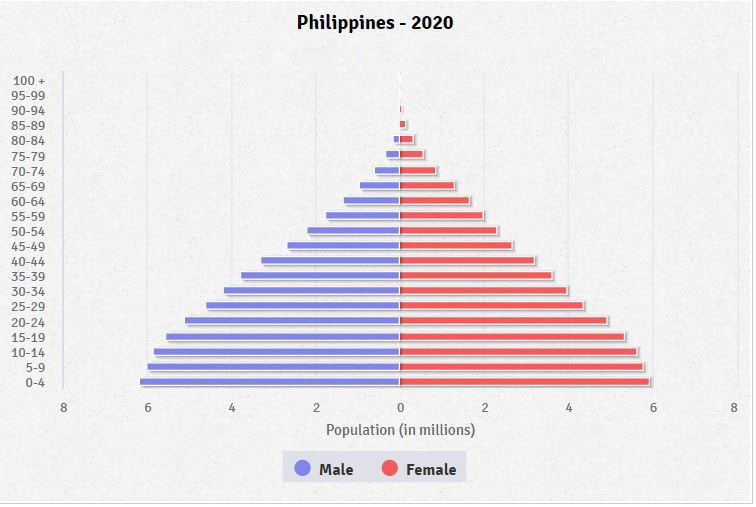
Examining the country’s population pyramid, it is clear that the age distribution in this Southeast Asian nation is very different from countries like Hungary. The largest segment of the population is under four years old, and over 27% of the total population is under the age of 19. As a result, in the coming years, the number of young people entering the labour market is expected to exceed 10 million.
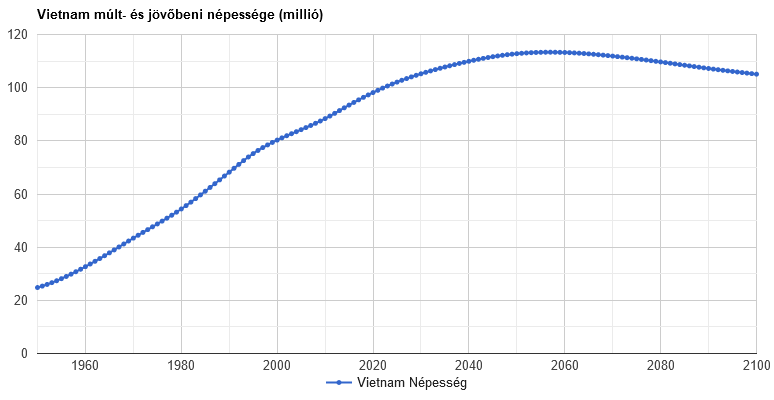
The population has been growing steadily over the decades. As shown in the second chart, the population increased from 27 million in the 1960s to 109 million by 2020. This growth trend is expected to continue in the future.
ECONOMY:
The Philippines can be described as an agro-industrial country. Its main agricultural products include rubber, sugarcane, coconut, rice, corn, bananas, cassava, pineapple, and mangoes.
Areas that originally served as American military bases have been converted into industrial parks. As a result, the country has a significant electronics manufacturing sector, as well as textile and footwear industries. Approximately 50–60% of the processing industry is concentrated in the expanding metropolitan area of Manila.
The Philippines’ main export partners are the United States (36%), Japan (17%), Germany (5%), and the Netherlands (5%).
LABOUR MARKET:
As of February 2022, the unemployment rate in the Philippines was 6.4%. According to a 2019 survey, 22.86% of employees worked in agriculture, 19.12% in industry, and 58.03% in the services sector.
Although the Philippines is a continuously developing country, the growing population creates an increasing demand for employment opportunities. Since the domestic labour market cannot fully absorb this demand, millions of Filipinos currently work abroad.
INTERCULTURAL CHARACTERISTICS:
For Filipino employees, two key cultural indicators—based on Hofstede’s dimensions—are particularly important in the workplace: collectivism and power distance. A high level of collectivism indicates that individuals perform best within a group setting. Consequently, shared team goals are significantly more motivating than individual self-actualisation.
High power distance highlights the importance of hierarchy in the workplace. Filipino workers place great value on respect and on being able to look up to their leaders. They tend to perceive the manager-subordinate relationship as unequal, whereas in some countries (e.g., Hungary), this relationship is more often viewed as a partnership.
Due to the high collectivism factor, community activities (such as team sports) are especially important. In addition, Filipino groups working abroad often engage in volunteer activities, spending their free time together in meaningful ways.
For more detailed insights into this topic, please refer to our free booklet:
www.pannonjob.hu/_upload/editor/BOOKLET/AZ_INTERKULTURALIS_EGYUTTM__KODES_A_GYAKORLATBAN_1-2.pdf
EDUCATION:
Filipinos are among the largest English-speaking populations in the world. In addition, many speak Spanish and French. The country’s colonial history has also had a significant impact on its education system. Intellectual life and higher education institutions are primarily concentrated in the capital, Manila.
GASTRONOMY:
Filipino cuisine is a blend of Chinese, Malay, and Spanish flavors. Onions, garlic, and ginger are commonly used for seasoning. American influence is also evident, with fast-food restaurants widely present throughout the country. As in many other Asian countries, rice is a staple food in the Philippines. The country also has a notable brewing tradition and takes pride in its local beer brands.
We believe that understanding the culture of our employees is essential for effective communication, reducing turnover, and ultimately ensuring long-term, successful collaboration.
If you are considering employing foreign workers or would like to make the integration of employees arriving from abroad more effective, please do not hesitate to contact us.