

Ukraine
UKRAINE
Get to know the home country of our employees
Why Ukraine? Since 2017, Ukrainian employees have been able to work in Hungary under a simplified employment procedure. In the case of shortage of certain professionals defined by government regulation, Ukrainian workers arriving in Hungary may take up employment for up to 90 days within a 180-day period without the need for any work permit.
In addition to the simplified procedure, the geographical proximity of Ukraine is another important advantage. As it is well known, a significant Hungarian minority lives in Ukraine. Hungarian-speaking workers arriving from the Transcarpathian region play a key role in interpretation and administrative processes. While some Ukrainian employees speak Ukrainian, communication with other candidates is typically conducted in Russian. Due to the cultural proximity of the two neighboring countries, Ukrainian workers generally integrate easily into Hungarian society.
Thanks to Ukraine’s strong education system, the country has one of the highest literacy rates, resulting in a workforce that is generally well educated and often possesses a high level of industrial experience. Unfortunately, the current wartime situation has made recruitment processes more challenging.
GENERAL INFORMATION:
Ukraine is an Eastern European country and, after Russia, the second largest country in Europe by area. The former Hungarian region of Transcarpathia became part of Czechoslovakia following the Treaty of Trianon, and later formed part of the Ukrainian Soviet Socialist Republic between 1945 and 1991.
Following the territorial rearrangements after World War II, further border changes took place in Ukraine. In 1954, Nikita Khrushchev transferred the Crimean Peninsula to Ukraine. In 2014, following a disputed regional referendum, Russia annexed the Crimean Peninsula, and after years of conflict in eastern Ukraine, launched a full-scale military invasion of Ukraine on 24 February 2022.
Ukraine’s current population is approximately 41 million. The official state language is Ukrainian, while Russian is also widely spoken. The ethnic composition of the population is as follows: Ukrainian (77.8%) and Russian (17.3%). The majority of the population follows the Orthodox faith; however, in regions such as Galicia, Bukovina and Transcarpathia, Greek Catholic communities are more prevalent.
DEMOGRAPHICS:
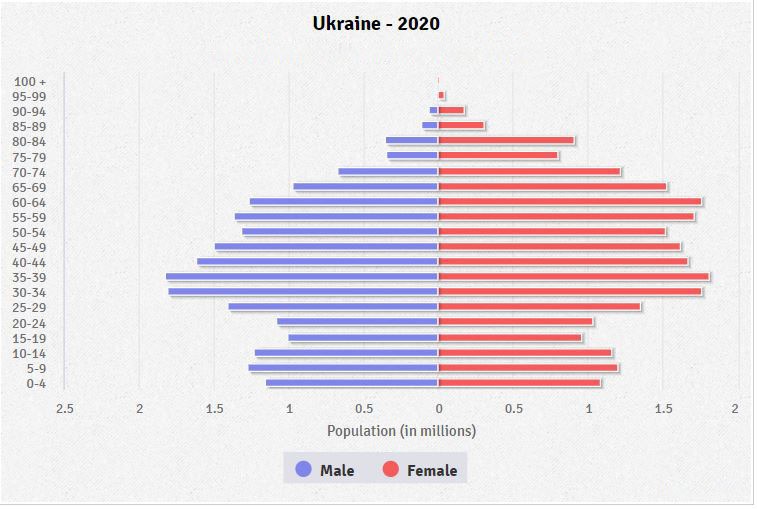
When comparing Ukraine’s population pyramid with those of the Asian countries presented in one of our other articles, it becomes clear that, similarly to Vietnam, the population in its thirties represents a significant segment. At the same time, a larger proportion of the population already falls within the over-40 age group.
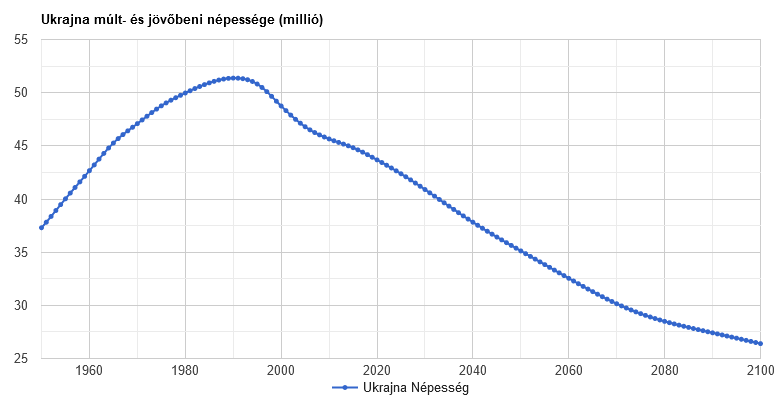
In terms of population trends, Ukraine’s demographic development shows similarities to Hungary’s, particularly due to the declining trend. Although the population increased in the decades following the 1960s, a turning point occurred in the mid-1990s, after which a steady decline can be observed. This trend is expected to continue in the coming years.
ECONOMY:
During the Soviet era, Ukraine was an important agricultural and industrial region. At one time, the country accounted for approximately one quarter of total Soviet agricultural output. Thanks to its favorable natural conditions, Ukraine could still be one of Europe’s leading food suppliers today; however, the development of private farming is still ongoing.
The country’s energy production has traditionally been based on Russian natural gas and crude oil. Its main export products include metallurgical goods, machinery, agricultural and food industry products, as well as plant-based commodities such as cereals and sunflower seeds. Ukraine’s key export partners include Russia (9.2%), Poland (6.5%) and Turkey (5.6%).
Unfortunately, in recent years Ukraine has faced significant economic and political challenges, resulting in limited domestic opportunities and prompting many people to seek employment abroad.
LABOUR MARKET:
In the first quarter of 2021, the employment rate of the population aged 15–70 stood at 55%, rising to 64.1% by December 2021. During the same period, Ukraine’s unemployment rate was 10.6%.
The wartime situation has, of course, had a significant impact on both the economy and the labour market. In response to the conflict, the European Commission has been supporting people arriving from Ukraine by helping them acquire the skills required for employment within the European Union and assisting them with labour market integration.
INTERCULTURAL CHARACTERISTICS:
Key cultural indicators that are particularly relevant in the workplace environment—based on Hofstede’s cultural dimensions—include collectivism and power distance. In the case of Ukraine, both dimensions are notably high, similarly to other potential source countries.
A high level of collectivism indicates that individuals tend to perform best within a group setting. As a result, shared team goals are significantly more motivating than individual self-actualisation. High power distance, on the other hand, highlights the importance of hierarchy in the workplace. Ukrainian employees generally place great value on respect and on being able to look up to their leaders. They tend to perceive the relationship between managers and subordinates as unequal, in contrast to some countries (such as Hungary), where leadership relationships are more often viewed as partnership-based.
For more detailed insights into this topic, please refer to our free booklet:
www.pannonjob.hu/_upload/editor/BOOKLET/AZ_INTERKULTURALIS_EGYUTTM__KODES_A_GYAKORLATBAN_1-2.pdf
EDUCATION:
Ukraine has one of the lowest illiteracy rates in the region, indicating a solid foundation in its education system. Notably, Ukraine ranks fourth in Europe in terms of the number of higher education graduates.
The country has also been a popular study destination for students from Asia and Africa. Prior to the Russian military operation in 2022, more than 63,000 international students were enrolled in Ukrainian higher education institutions, primarily from Turkmenistan (approximately 10,000 students) and Azerbaijan (around 9,700 students).
A significant proportion of employees arriving in Hungary from Ukraine also hold higher education qualifications.
GASTRONOMY:
Various baked goods, meat dishes, dairy products, and honey-based beverages are very popular in Ukraine. An interesting Christmas tradition is the twelve-dish dinner. Popular Ukrainian dishes include borscht, Chicken Kiev, varenyky (dumplings), and plov (a one-pot dish typically made with meat and rice).
We believe that understanding the culture of our employees is essential for effective communication, reducing turnover, and ultimately ensuring long-term, successful collaboration.
If you are considering employing foreign workers or would like to make the integration of employees arriving from abroad more effective, please do not hesitate to contact us.